


 Cart
Cart
 sales@molnova.com


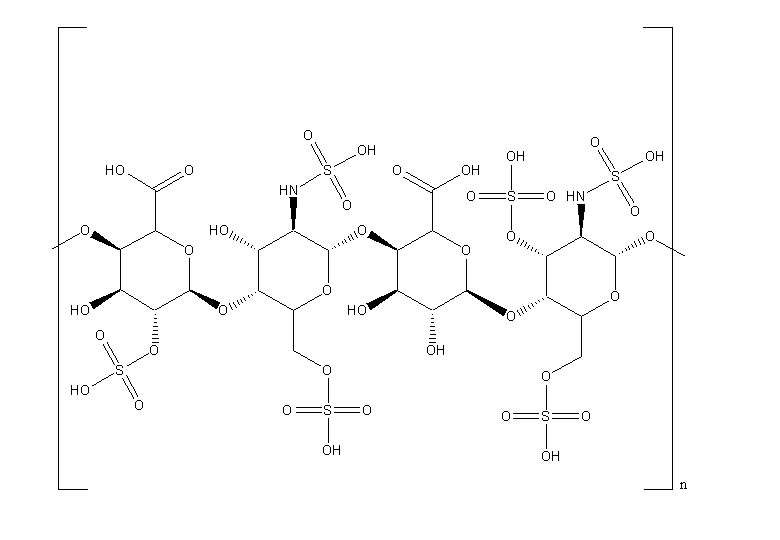
Heparan Sulfate
CAS No. 9050-30-0
Heparan Sulfate( —— )
Catalog No. M24941 CAS No. 9050-30-0
Heparan Sulfate is a complex and linear polysaccharide, exists as part of glycoproteins named heparan sulfate proteoglycans, which are expressed abundantly on the cell surface and in the extracellular matrix.
Purity : >98% (HPLC)
 COA
Datasheet
HNMR
HPLC
MSDS
Handing Instructions
COA
Datasheet
HNMR
HPLC
MSDS
Handing Instructions
| Size | Price / USD | Stock | Quantity |
| 5MG | 87 | In Stock |


|
| 10MG | 147 | In Stock |
|
| 25MG | 290 | In Stock |
|
| 50MG | 484 | In Stock |
|
| 100MG | 699 | In Stock |
|
| 200MG | Get Quote | In Stock |
|
| 500MG | Get Quote | In Stock |
|
| 1G | Get Quote | In Stock |
|
Biological Information
-
Product NameHeparan Sulfate
-
NoteResearch use only, not for human use.
-
Brief DescriptionHeparan Sulfate is a complex and linear polysaccharide, exists as part of glycoproteins named heparan sulfate proteoglycans, which are expressed abundantly on the cell surface and in the extracellular matrix.
-
DescriptionHeparan Sulfate is a complex and linear polysaccharide, exists as part of glycoproteins named heparan sulfate proteoglycans, which are expressed abundantly on the cell surface and in the extracellular matrix.
-
In VitroHeparan sulfate is a linear polysaccharide and belongs to the family of glycosaminoglycans. Heparan sulfate is composed of glucuronic acid (GlcA) and iduronic acid (IdoA) residues as well as N-acetyl glucosamines (GlcNAc) with various sulfation modifications, and is typically 50-200 disaccharides in length. Heparan sulfate interacts with numerous proteins, including growth factors, morphogens, and adhesion molecules, and thereby regulates important developmental processes in invertebrates and vertebrates. Heparan sulfate chains regulate developmental signaling by acting as co-factors through a variety of mechanisms that include but are not limited to maintenance of morphogen gradients and co-receptor functions.Heparan sulfate proteoglycans can act as receptors for proteases and protease inhibitors regulating their spatial distribution and activity. Membrane Heparan sulfate proteoglycans act as coreceptors for various tyrosine kinase-type growth factor receptors, lowering their activation threshold or changing the duration of signaling reactions. Heparan sulfate influences the binding affinity of intestinal epithelium cells to Wnt, thereby promoting activation of canonical Wnt signaling and facilitating regeneration of small intestinal crypts after epithelial injury.
-
In VivoDigestion of heparan sulfate impairs context discrimination in a fear conditioning paradigm and oscillatory network activity in the low theta band after fear conditioning. Thus, heparan sulfate maintains neuronal excitability and, as a consequence, support synaptic plasticity and learning. FGF-2/FGFR system is involved in the regulation of astrocytic reactivity and/or proliferation in the brain and its action is potentiated by heparan sulfate.
-
Synonyms——
-
PathwayProteasome/Ubiquitin
-
TargetEndogenous Metabolite
-
RecptorFGFR|Human Endogenous Metabolite|Wnt
-
Research Area——
-
Indication——
Chemical Information
-
CAS Number9050-30-0
-
Formula Weight593.47(monomer)
-
Molecular FormulaC12H19NO20S3 (monomer)
-
Purity>98% (HPLC)
-
SolubilityH2O : 100 mg/mL (Need ultrasonic)
-
SMILES——
-
Chemical Name——
Shipping & Storage Information
-
Storage(-20℃)
-
ShippingWith Ice Pack
-
Stability≥ 2 years
Reference



-
Campesterol
Campesterol is a plant sterol with cholesterol lowering and anticarcinogenic effects, it and other plant sterols often decrease LDL cholesterol levels overall. Campesterol has anti-inflammatory effect, it inhibits several pro-inflammatory and matrix degradation mediators typically involved in osteoarthritis- induced cartilage degradation, also sometimes used to treat some specific prostate conditions.
-
Isobutyric acid
Isobutyric acid is a carboxylic or short chain fatty acid with characteristic sweat-like smell. Small amount of isobutyrate is generated via microbial (gut) metabolism.
-
DL-Homocysteinethiol...
DL-Homocysteinethiolactone hydrochloride is a cysteine derivative that binds to and induces conformational changes in various plasma proteins slowing coagulation and inducing oxidative stress.?It decreases left ventricular systolic blood pressure and cardiac force and induces seizures in vivo.
